LATEST NEWS
Share this newsTop 20 Biggest Transfers: SL Benfica and the Economics of Talent
Monday, Dec 15 2025
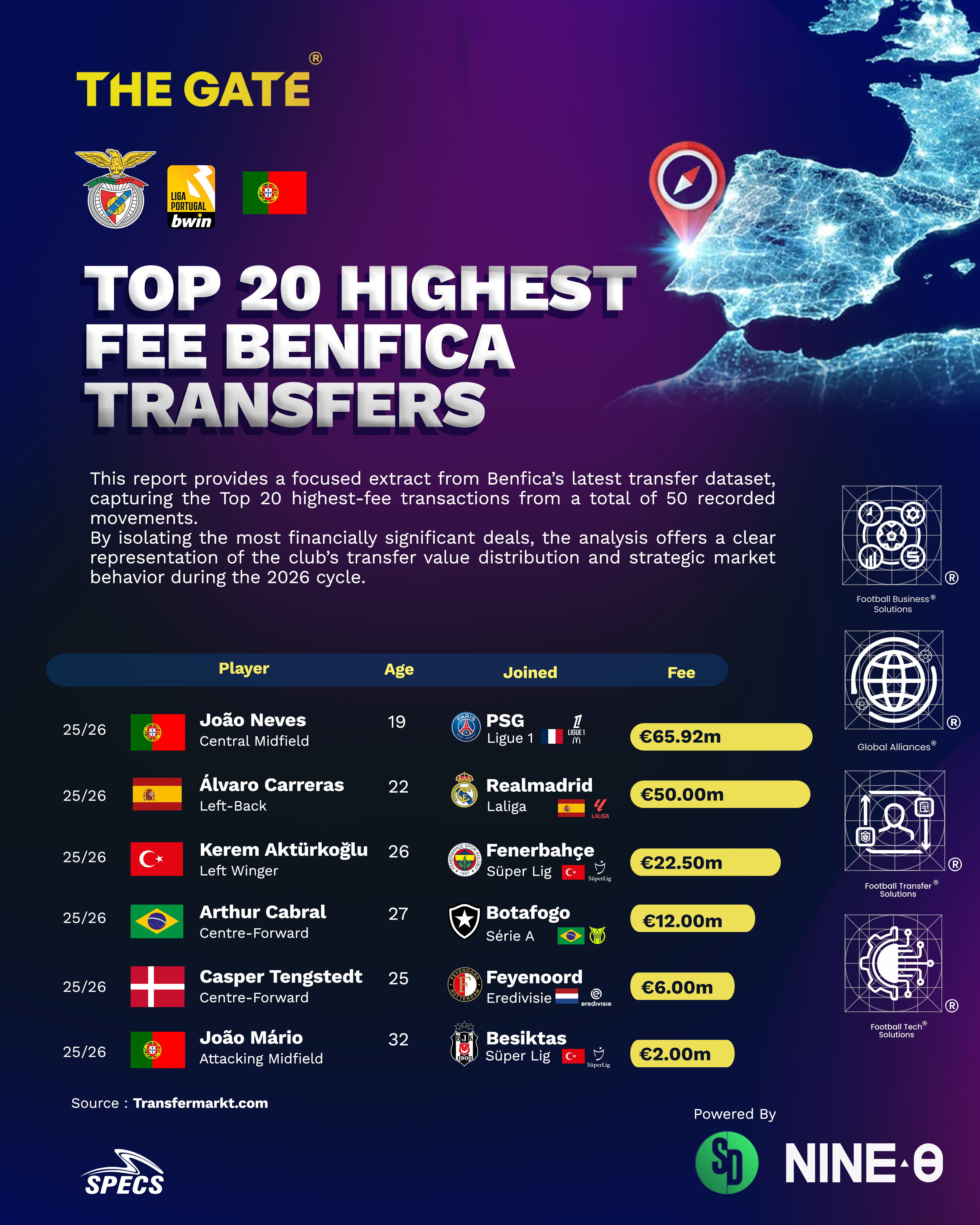
SL Benfica has established itself as one of the most effective institutions in global football when it comes to transforming talent into long-term economic value. While many clubs focus heavily on short-term sporting results, Benfica has built a repeatable system where player development, performance exposure, and market strategy are fully integrated.
The club’s Top 20 biggest transfers are not isolated successes, but the outcome of a clearly defined football and business philosophy.
A System, Not Individual Transactions
What distinguishes Benfica from many clubs is its ability to remove dependency on individual players. Instead of relying on star power, Benfica prioritizes system strength. Talent identification begins early, often targeting profiles with high development ceilings rather than immediate impact.
Once integrated, players are placed in an environment designed to accelerate value growth: competitive domestic fixtures, regular European exposure, and a tactical framework that highlights individual strengths within a collective structure.
Market Timing as a Competitive Advantage
One of the most critical elements in Benfica’s transfer success is timing. The club rarely sells under pressure. Transfers are executed when three factors align: peak performance metrics, strong external demand, and favorable market conditions.
This disciplined approach allows Benfica to operate from a position of leverage, consistently achieving premium valuations in an increasingly volatile transfer market.
Alignment Between Sporting and Financial Objectives
Benfica’s model demonstrates that sporting ambition and financial discipline do not have to be conflicting goals. Transfer revenues are reinvested strategically, supporting squad renewal while preserving financial stability.
This alignment enables the club to remain competitive across multiple cycles without entering unsustainable spending patterns. In an era shaped by Financial Fair Play regulations and rising operational costs, such balance is no longer optional—it is essential.
Global Demand for Developed Talent
The sustained presence of Benfica-developed players across Europe’s top leagues underlines the club’s reputation as a trusted source of elite-ready talent. Buying clubs recognize that players emerging from Benfica’s system are not only technically prepared but also tactically adaptable and mentally conditioned for high-pressure environments.
This reputation itself becomes a value driver, reducing market friction and increasing demand across transfer windows.
Scalability and Replicability
Perhaps the most significant strength of Benfica’s approach lies in its scalability. The club has demonstrated that its model can be repeated across generations, adapting to changes in football economics, data usage, and competitive dynamics.
Rather than chasing trends, Benfica refines processes—scouting networks, performance analysis, contract structuring, and exposure pathways—ensuring long-term resilience.
Implications for Modern Football Strategy
Benfica’s Top 20 transfer record offers a broader lesson for clubs and football organizations worldwide: success in the transfer market is rarely accidental. It is the product of governance, clarity of vision, and patience.
As transfer fees continue to rise and regulatory scrutiny intensifies, clubs that treat talent as a structured asset—rather than a speculative bet—will hold a decisive advantage.
Conclusion
SL Benfica’s position among football’s most successful selling clubs is the result of strategic consistency rather than coincidence. The Top 20 biggest transfers in the club’s history reflect a mature football business model where development, exposure, and timing converge.
In modern football, where sustainability is increasingly linked to intelligence rather than expenditure, Benfica stands as a reference point for how value is built, protected, and ultimately realized
RELATED ARTICLES

Friday, Mar 13 2026
StreamAMG partners with international football solutions provider THE GATE™

Saturday, Jan 3 2026
THE GATE™ 2026: Redefining the Landscape of Football Innovation and Solutions

Saturday, Dec 20 2025
Football Tech Solutions × Global Alliances: THE GATE® and Scout Decision

Saturday, Dec 6 2025
NEW CHAPTER: BELGIUM
Saturday, Nov 29 2025
Transfer Outlook: Challenger Pro League